Growth That Keeps Its Soul
Why the Best Programs Know When to Stop Installing and Start Deepening
I’m writing this in the middle of three things happening at once.
We’re wrapping up our current recruiting class. We’re already building the next one. And we’re in the thick of spring football, where the guys on campus right now need development, attention, and honest coaching every single day while balancing their academic, strength and college student load.
All three of those things matter. All three demand energy. And if I’m not careful, the pull of the new will quietly starve the work that’s already in front of me with our team on campus.
This is the tension every leader knows but rarely names out loud. Growth is exciting. Recruitment and the possible future possibilities of a team is exciting. New people, new potential, new energy walking through the door. But if the pursuit of what’s coming costs you the depth of what’s here, you haven’t grown. You’ve just gotten busier.
That distinction is the difference between building something and inflating something. And it’s worth more of our attention than it usually gets.
The Seduction of More
Every organization, every program, every team faces this. The pressure to expand. Add another initiative. Say yes to another opportunity. Bring in more people, more resources, more reach.
Mike Leach (among many coaches) used to say something that stuck with me: when you add something, what are you taking out? He was talking about an offense. A playbook. But the principle applies to everything. Every new install costs reps on the things you already run. Every new concept dilutes the depth of the concepts you’ve already committed to. At some point, the playbook gets so thick that nobody executes anything with precision. You’ve got a hundred plays and your kids are thinking instead of playing.
That same pressure shows up off the field too. And most of it comes wrapped in praise. “You’re growing so fast.” “People are noticing.” “You need to capitalize on this momentum.” It sounds like encouragement. It feels like validation. But underneath it, there’s a question nobody’s asking: is this growth aligned with who we actually are?
Because growth without alignment is drift. It doesn’t announce itself. It doesn’t feel like failure. It feels like success, right up until the moment you realize the thing you built doesn’t look like the thing you set out to build.
In coaching, I see it every cycle. The temptation to chase numbers on a recruiting board instead of building relationships that actually fit the program. The pull to prioritize the flashy commitment over the kid who’s going to show up every day and do the quiet work that holds a locker room together and develops into a good player. The urge to install something new you hear at a clinic instead of repping what you have until your guys can run it in their sleep. More isn’t always more. Sometimes more is just dilution wearing a jersey.
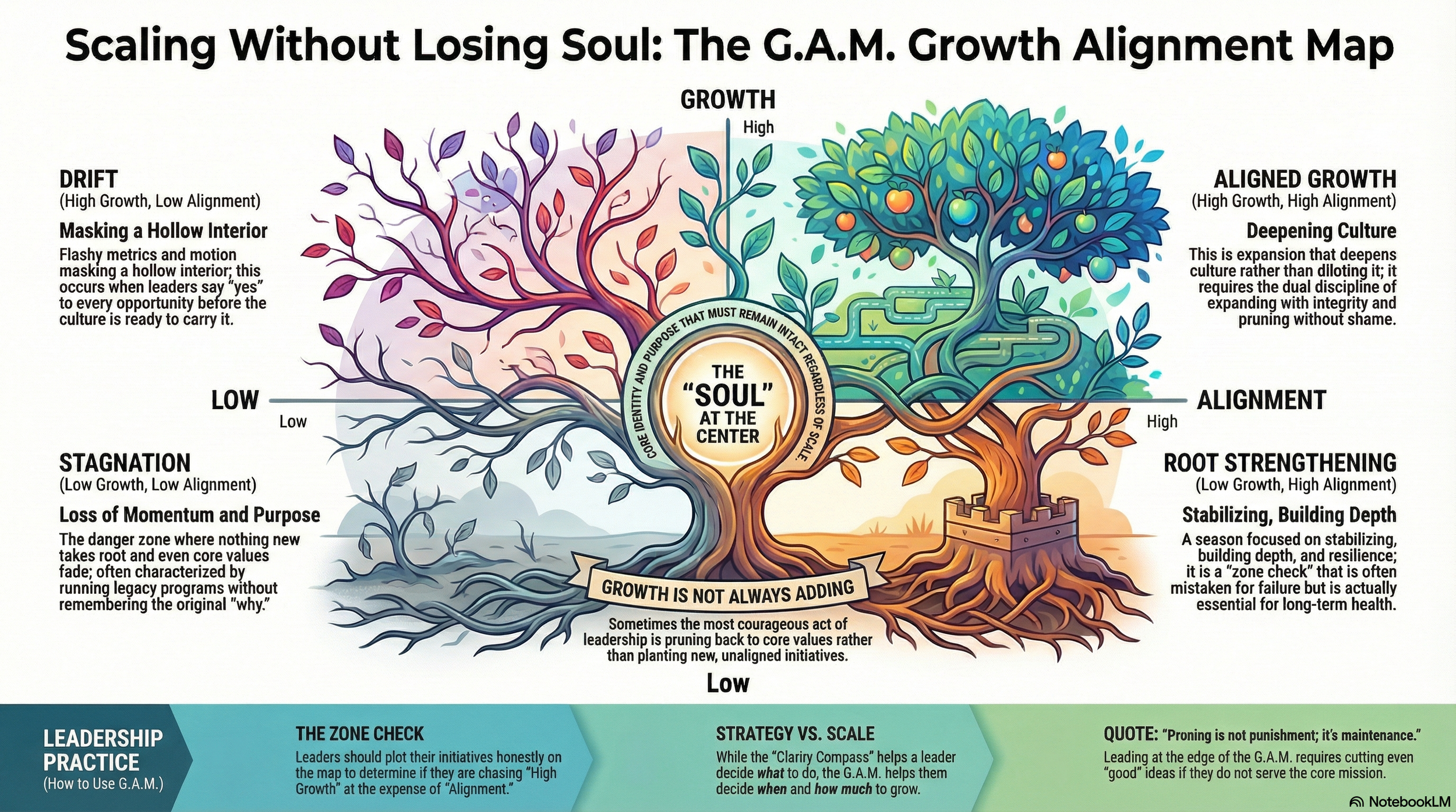
The Growth Alignment Map
There’s a framework in The Power of And called the Growth Alignment Map, or G.A.M. It’s built on a simple grid with two axes: growth on one side, alignment on the other.
Four zones.
High growth, high alignment. This is the goal. Expansion that deepens culture instead of diluting it. You’re adding people, capacity, reach, and the core identity of the program gets stronger in the process. This is what it looks like when a recruiting class doesn’t just fill spots but raises the standard of the room.
High growth, low alignment. This is drift. The numbers look impressive. The outside world is congratulating you. But inside, things are thinning. The culture is stretching. The people who built what you have are burning out holding it together while new pieces get added on top. You’ve seen programs like this. Big recruiting classes that blow up a locker room because nobody did the alignment work underneath the talent acquisition.
Low growth, high alignment. This is root strengthening. It’s the quadrant most leaders are afraid of because it looks like a plateau from the outside. It’s not. It’s the season where you’re not adding, you’re deepening. You’re developing the guys already in the building. You’re reinforcing culture. You’re doing the invisible work that makes the next phase of growth sustainable. Spring football lives in this quadrant. Nobody’s posting about it on signing day. But it’s where programs are actually built.
Low growth, low alignment. Stagnation. Nothing new is taking root and even the core values are fading. Nobody wants to be here. But naming it honestly is the first step out.
At the center of the map is one word: Soul.
Because scaling without soul is not growth. It’s hollowing.
Where Coaching Lives Right Now
Here’s what this looks like for me this spring.
Finishing one recruiting class means evaluating whether the people we brought in actually fit what we’re building. Not just talent. Fit. Character. Work ethic. Academic Alignment. The willingness to be coached hard and not take it personally. Did we recruit aligned, or did we recruit impressive or just bodies?
Starting the next recruiting class means resisting the pull to just start stacking offers based on film and measurables and what our perceived competitors are doing. The evaluation has to go deeper than that. Who is this kid when nobody’s watching? What does he add to the room, not just the roster? That takes more time. It’s slower. And it’s the only way to build something that holds.
Spring football is the root-strengthening work. This is where the guys already in the program either grow into what we need them to be or they don’t yet. And the quality of that development depends entirely on whether the coaching staff is present with them or mentally already chasing the next class. You can’t develop the roster you have if your attention is already on the roster you want.
It’s the same with the install. Spring is where you find out if your base concepts actually hold. The temptation is to keep adding. New wrinkles, new formations, new looks. But every rep spent on something new is a rep taken from something foundational. The Leach question applies here too. What are you taking out? If the answer is “nothing, we’re just adding,” your guys are going to be a mile wide and an inch deep by August. The best spring practices I’ve been part of are the ones where we ran fewer things better, not more things poorly.
All three of those things are real. All three are happening at the same time. The G.A.M. doesn’t tell me which one to prioritize. It tells me to check whether each one is aligned with the identity of what we’re building. And if it’s not, to have the honesty to adjust before drift becomes the default.
The Courage to Stabilize
One of the hardest things for any competitive person to do is choose depth over breadth. It feels counterintuitive. Especially in environments where growth is the scoreboard. More recruits. More wins. More visibility. More followers.
But here’s what I’ve learned. The programs that last, the ones that sustain success over years instead of having one big cycle followed by a collapse, are the ones that know when to stabilize. They know when to stop adding and start deepening. They treat root strengthening not as a consolation prize but as a strategy.
Saying no to an opportunity that doesn’t align is not timidity. It’s stewardship. Choosing to develop the 60 guys in your building instead of chasing 20 new ones isn’t settling. It’s building.
The bravest growth often happens when you return to the core instead of reaching for the edge.
A Diagnostic Question
Here’s the G.A.M. question I keep coming back to:
Does this growth match who we are? Or are we expanding into something we won’t recognize in two years?
You can ask it about a recruiting class. A business expansion. A new role you’re considering. A relationship you’re investing in.
If the answer is “this deepens who we are,” move forward. If the answer is “this looks good but something feels thin,” pay attention to that. Drift doesn’t announce itself. It shows up as exhaustion in the people holding things together while the expansion keeps rolling.
Try It Monday
Pick one area of your life or leadership where growth is happening. Could be your team, your business, your personal development.
Now plot it honestly on the G.A.M.
Is it high growth and high alignment? Good. Keep building.
Is it high growth but something feels off underneath? That’s drift. Name it before it names you.
Is it low growth but the roots are getting stronger? That’s not failure. That’s foundation work. Stay with it.
Is it stalled on both fronts? Be honest. Then decide what needs to change.
The map doesn’t judge. It just tells you where you are so you can choose where you go next.
Go Deeper
The Growth Alignment Map is one of seven frameworks in The Power of And. In the book, you’ll see it tested by leaders making real decisions about when to expand, when to prune, and how to tell the difference between momentum and drift.
For weekly frameworks, coaching and leadership stories, and practical tools you can use the same week you read them:
Subscribe to the newsletter → Next up: The Anchor Model, and what it means to ground yourself before the room asks you to perform certainty.
Keep leading with both.
Jeff Thomas is a leadership practitioner, coach, and author of The Power of And and the forthcoming “Power of” leadership series, published by Field and Forge Press.