The Layer You're Leading From Matters More Than You Think
Most leadership advice focuses on what you decide. Very little of it focuses on where you're deciding from.
That distinction is the difference between a leader who handles things and one who changes things.
Here's what I mean.
When a crisis lands on your desk — a difficult employee situation, a community complaint, a budget cut, a public incident — the natural instinct is to respond. Fast. Decisively. In the lane that feels most urgent. Usually that means diving into tactics: who handles what, what gets communicated, what gets documented.
That's not wrong. But it's incomplete.
Because in any real leadership moment, you're not managing one problem. You're standing inside several simultaneous demands that live on different planes — and the quality of your leadership depends on whether you can recognize all of them, move between them, and match your posture to what each one actually requires.
That's what I've come to call Layered Leadership.
The Four Layers
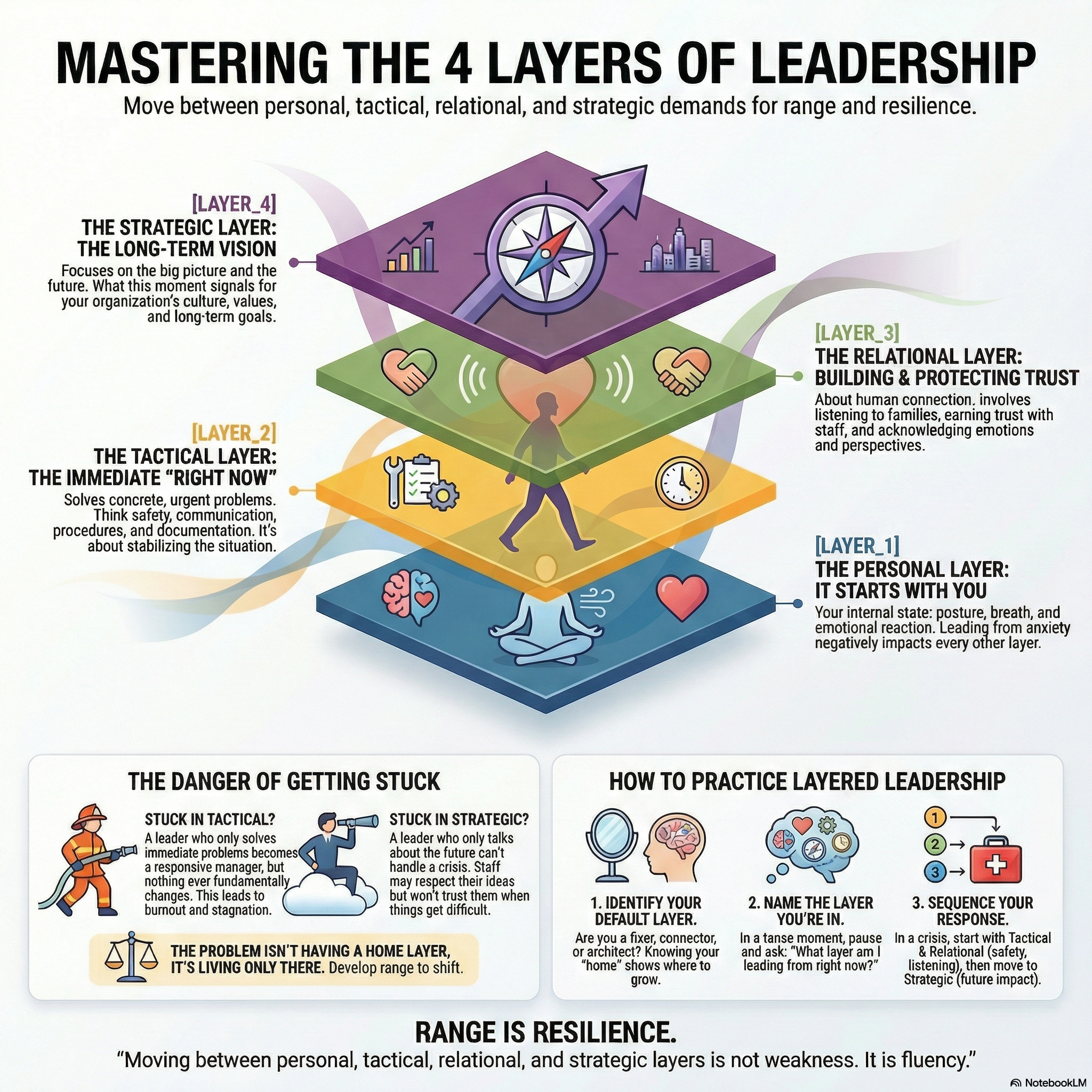
Leadership never happens at a single altitude. Most experienced leaders know this intuitively, even if they've never had a name for it. There are at least four distinct layers active in any significant leadership moment:
The Personal Layer. This is your internal posture — your breath, your reactivity, your emotional state. It's the layer most leaders skip entirely, because it feels invisible or self-indulgent. But it's quietly upstream of everything else. If you enter a difficult conversation from anxiety or defensiveness, that will shape the message before you've said a word. The personal layer doesn't compete with the others — it primes them.
The Relational Layer. This is trust — with your team, your community, the individuals directly involved in the moment. It's not just about being liked. It's about whether people believe you're seeing them, not just managing them. Tactical decisions made without relational awareness get technically correct but organizationally damaging.
The Tactical Layer. This is the work most leaders spend the majority of their time in — solving immediate problems, handling procedures, making decisions that need to be made today. It's necessary. But it has a gravity that pulls everything toward it. When the tactical layer becomes the only layer, you stop leading and start containing.
The Strategic Layer. This is the long view — what this moment signals, what systems need to change, what the organization will believe about itself based on how leadership responds. The strategic layer is where reactive patterns become culture, for better or worse.
None of these layers is more important than the others. The failure isn't choosing the wrong one — it's pretending only one exists.
The Trap Most Leaders Fall Into
I once worked alongside a leader who was one of the most responsive people I've ever seen. Teachers loved him. Parents praised his availability. His phone rang constantly, and he answered it. Every conflict, every complaint, every concern — he handled personally.
But nothing ever changed.
The same problems surfaced year after year. The same dynamics. The same friction. Because he never stepped into the strategic layer long enough to redesign the systems that kept producing those problems. What looked like dedication was actually containment. Maintenance dressed up as leadership.
He was exhausted. The organization had not moved an inch.
That's the tyranny of the tactical layer — and it's the most common trap for conscientious leaders, because it's rewarded in the short term and depleting over time.
The opposite failure is equally real. Some leaders live almost entirely in the strategic layer — visionary language, long-horizon thinking, frameworks for the future — while their teams drown in problems that need someone to actually show up. The ivory tower trap. Altitude without presence.
Great leaders move. The skill is not choosing between layers. It's developing the range to navigate them — without losing your footing.
What This Looks Like in Practice
In crisis moments, all four layers activate simultaneously. Leadership rarely fails because someone chooses the wrong layer. It fails because leaders pretend only one layer exists.
When something breaks — publicly, urgently, emotionally — the tactical instinct says: respond fast, communicate clearly, document everything. That matters. But the relational layer is also active: Are people watching not just what I say, but how I say it? Does this response protect or damage trust? The strategic layer is also present: What will this moment communicate about who we are long after the immediate situation resolves? And underneath all of it, the personal layer is asking: Am I leading from clarity or from anxiety right now?
Miss one of those layers, and the others weaken.
A technically clean response that ignores the relational layer creates compliance without trust. A relationally warm response that ignores the tactical layer creates goodwill without resolution. Strategic vision that skips the personal layer produces sound ideas from an unsteady source.
The layers aren't a checklist. They're a practice of attention — learning to notice, in real time, which layers are demanding presence and which one you're defaulting to out of habit.
A Diagnostic Question
Here's the most useful question I know for layered leadership work:
Which layer am I actually leading from right now — and is that the layer this moment needs?
Not: Am I working hard? Not: Am I making decisions? But: Where am I operating, and does it match what's actually required?
Sometimes the moment needs you in the tactical layer, hands on the immediate problem. Sometimes it needs you in the relational layer, simply present with someone who is struggling. Sometimes the most powerful thing you can do is step back into the strategic layer and ask what system is producing the pattern you keep responding to. And sometimes — more often than we acknowledge — leadership begins in the personal layer: a pause, a breath, a deliberate reorientation before you ever open your mouth.
Range is what separates leaders who handle things from leaders who change them.
If you're interested in exploring the complete framework — including the mapping worksheet designed to help you identify where you're operating and whether it matches the moment — The Power of And is available on Amazon. And if you'd like the companion tools, including the Layered Leadership Mapping Worksheet, you can access the Digital Companion Library at www.coachjeffthomas.com.
Jeff Thomas is a leadership practitioner, former coach, and author of The Power of And and the forthcoming "Power of" leadership series.